The September Reset: Why Fresh Seasons Start with Subtraction, Not Addition
Summer is behind us, and a new working season begins. Why trying to start fresh by stacking new habits leads to burnout, and how to harness the quiet power of intentional subtraction.
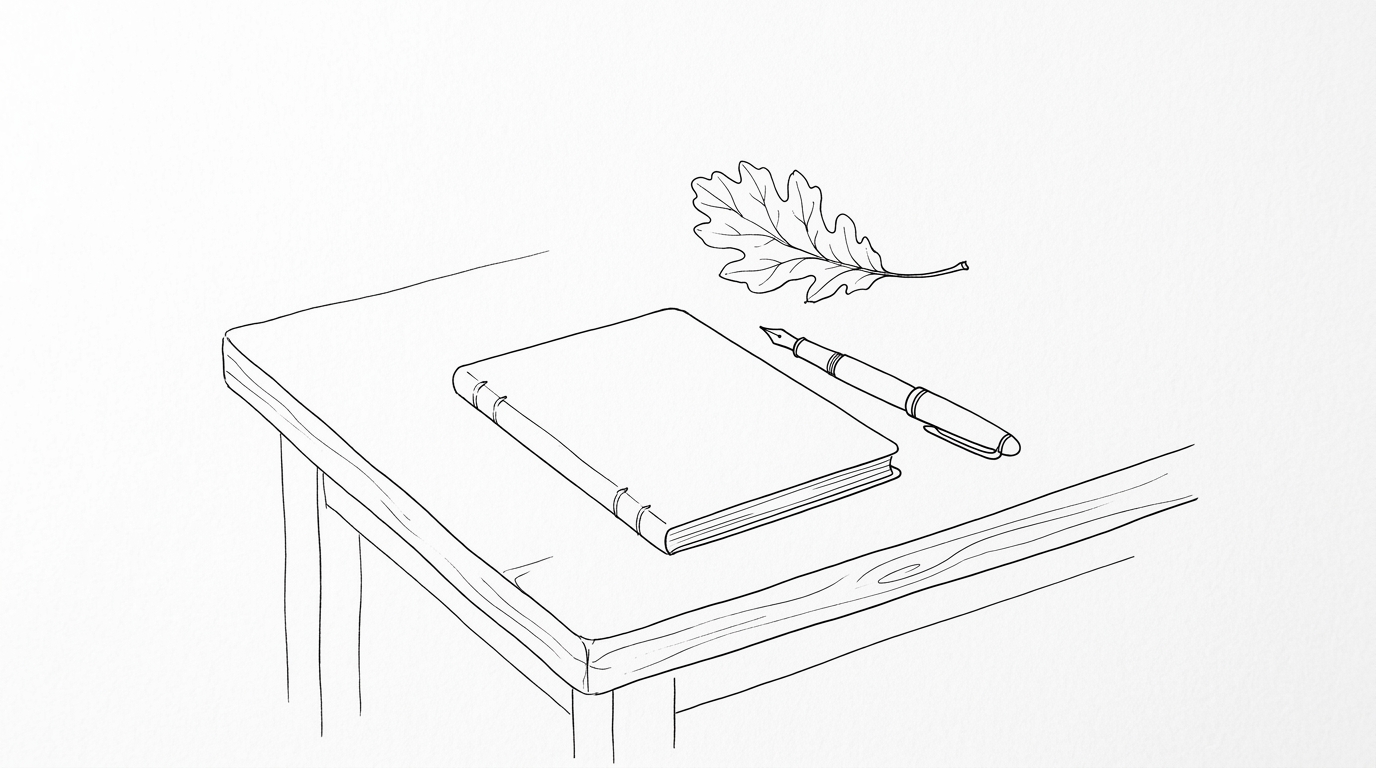
September Is the Real New Year
In our calendar, there are two distinct psychological reset points: January 1st and September 1st. But while January often finds us sluggish in the midst of dark winter holidays, the beginning of September carries an entirely different energy. Behind us lie summer, sunlight, restorative vacations, and a change of scenery. We feel recharged, optimistic, and eager to tackle ambitious goals.
Naturally, we sit down to plan our fresh start and fall into a classic cognitive trap:
- Enrolling in two comprehensive online courses at once;
- Committing to 6:30 AM runs every single weekday;
- Setting a target to read 15 heavy non-fiction books before winter;
- Buying a pristine leather planner and configuring an intricate 12-step habit tracker;
- Reviving three stalled side projects simultaneously.
Sound familiar? Statistically, by mid-October, more than 80% of these well-intentioned autumn overhauls collapse under their own weight. The initial wave of dopamine subsides, exhaustion sets in, and with it comes a toxic sense of personal inadequacy.
Why does this happen so reliably? Because we attempt to add a massive volume of new responsibilities onto a life system that is already operating near maximum cognitive capacity.
The Cognitive Trap: Addition Bias
In 2021, a team of behavioral scientists at the University of Virginia published a landmark paper in the journal Nature uncovering a fundamental quirk of human cognition known as Addition Bias. Through a series of experiments involving everything from Lego structures to organizational workflow designs, the researchers examined how people instinctively approach problem-solving.
The findings were striking: when asked to improve an existing system or solve a problem, human brains systematically default to adding components, routinely failing to consider subtraction. When participants were asked to make a toy building more stable, they built extra pillars rather than removing the unstable top layer. When teams were tasked with optimizing meetings, they proposed new agendas and checklists instead of simply eliminating obsolete recurring calls.
As Professor Leidy Klotz highlights in his insightful book «Subtract: The Untapped Science of Less», our minds are evolutionarily wired for accumulation: more tools, more territory, more food, more connections. In an era of scarcity, hoarding protected survival. In an era of relentless information overload, it guarantees chronic burnout.
“Perfection is achieved, not when there is nothing more to add, but when there is nothing left to take away.” — Antoine de Saint-Exupéry
Rather than aggressively piling new burdens onto your September calendar, minimalism offers the inverse philosophy: the ancient principle of Via Negativa (the negative way). Improving your life by removing friction, noise, and non-essential commitments yields far more reliable and sustainable progress than chasing new positive interventions.
Three Decluttering Zones Before Starting the Working Year
To give your genuine priorities a real chance to flourish, you must first carve out breathing room across three domains: physical, digital, and mental.
1. Physical Environment: Your Desk as a Blank Canvas
Your workspace acts as an external mirror of your mental state. If your desk is covered in old receipts, tangled cables, half-used notebooks from 2023, and promotional pens that barely write, your subconscious is constantly burning attention bandwidth processing that background clutter.
- Action Step: Perform a total desk reset. Clear off everything except your computer, a single quality notebook, and one reliable pen. Let the empty surface breathe.
- For an in-depth framework on functional workspace design, see Guide #19: The Minimalist Desk & Workspace.
2. Digital Space: Eliminating Cognitive Friction
Over the summer months, our digital devices quietly accumulate sludge: dozens of stray screenshots scattered across the desktop, hundreds of browser tabs left open “to read later”, and notifications that ping incessantly.
- Action Step: Close all dormant browser tabs. Empty your Downloads folder. Unsubscribe from 5 noisy newsletters or social media accounts that trigger anxiety, and silence all non-essential notification badges on your phone.
- Explore our foundational playbooks: Guide #02: Principles of Digital Hygiene and Guide #10: The Minimalist Smartphone Setup.
3. Commitments: The Courage to Close Open Loops
The heaviest invisible burden we carry is what psychologists call Open Loops—stalled promises, half-finished ideas, and ambiguous commitments dragging on for months. Each unfinished project consumes a slice of your cognitive RAM.
In his seminal book «Essentialism: The Disciplined Pursuit of Less», Greg McKeown reminds us that the ability to say a graceful, deliberate “no” to the non-essential is the only way to say an uncompromised “yes” to what truly matters.
- Action Step: Write down all lingering projects. Identify 3 items that you know you won’t realistically finish this season, and formally cancel them. Send a quick, professional note: “Due to a shift in focus this quarter, I will not be able to take this on.” You will immediately feel a profound surge of mental relief.
- Read more in Guide #16: Saying No and Calendar Decluttering.
Moving from Frenzy to Focus: Deep Work
Once the extraneous noise is stripped away, how should you channel your reclaimed focus?
Modern work culture is intoxicated by the illusion of pseudo-productivity: firing off instant Slack replies, attending back-to-back status syncs, and reshuffling tickets on Kanban boards. Yet genuine breakthrough value is created through Deep Work—the ability to focus without distraction on cognitively demanding tasks, as defined by computer science professor Cal Newport.
To establish a calm and potent work rhythm, adopt a simple principle: “The One Big Thing”. Dedicate the first 90 minutes of your workday to solitary, uninterrupted progress on your most important intellectual task—before checking emails, answering messages, or taking calls. Once that core block is complete, the rest of your day can absorb meetings and administrative chores. Even if the afternoon turns chaotic, your day was undeniably impactful.
Discover the science of single-tasking in Guide #20: Deep Work & Single-Tasking.
Practice of the Week: The September Subtraction Protocol
To translate these insights into immediate reality, set a timer for 30 minutes today and execute three specific subtractions:
- Subtract 5 physical items from your workspace—recycle old papers, store non-daily gadgets in a drawer, or throw away dried-out stationery.
- Subtract 3 information streams—unsubscribe from podcasts, feeds, or chat channels that drain your mood without adding substance.
- Subtract 1 obsolete goal—remove an obligation you set purely out of guilt or external expectations.
Real productivity isn’t about fitting more hustle into every waking hour. It is about having the clarity and courage to do less, with complete presence and lasting mastery.
Wishing you a calm, focused, and intentional autumn season.