The Minimalist Kitchen: Essential Tools Over Useless Gadgets
Why professional chefs rely on a handful of durable tools while home kitchens drown in single-use plastic gadgets, and how clearing your countertops reclaims the joy of cooking.
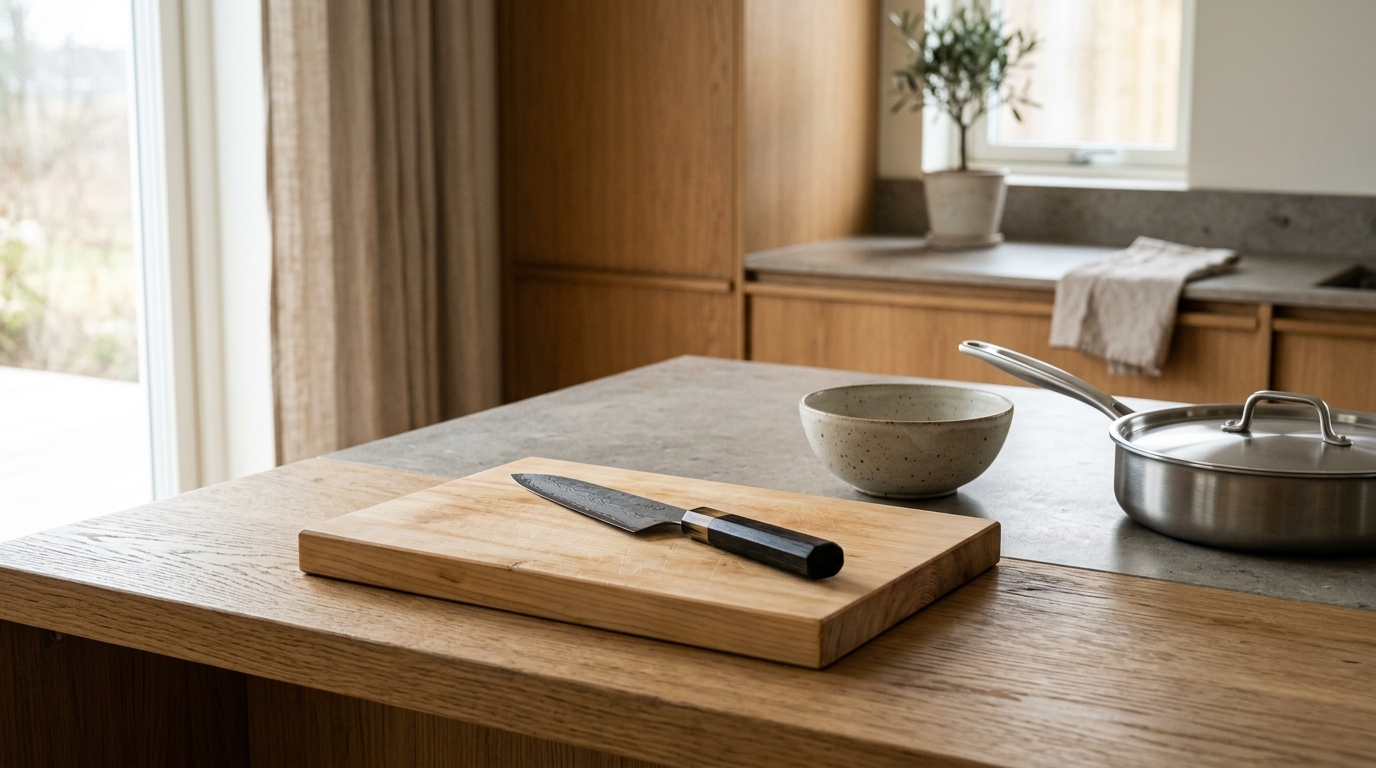
The Tyranny of the Unitasker
Open your kitchen cabinets and look inside with unsparing honesty.
Alongside your everyday pots and plates, you will likely find an uncanny museum of culinary optimism:
- An avocado slicer and pitter shaped like an oversized plastic fruit;
- A garlic peeler tube that rolls awkwardly across the counter and cleans poorly;
- A motorized spiralizer used exactly once for zucchini noodles in 2022;
- An electric egg-boiler when a pot of boiling water has worked for millennia;
- A monolithic 24-piece wooden knife block holding twenty dull, stamped blades you have never touched.
Modern consumer culture has spent half a century convincing us of a subtle falsehood: cooking is complicated and grueling, but buying this specialized gadget will make you a healthy, effortless chef.
The late food writer Alton Brown famously dubbed these contraptions unitaskers—appliances designed to perform precisely one solitary task, and usually performing it worse than an experienced hand with a sharp knife.
The tragic irony of the gadget-heavy kitchen is that instead of making cooking effortless, it turns it into an obstacle course. When preparing a simple Tuesday night dinner requires digging through a tangle of plastic attachments, finding matching lids, and dreading the cleaning of motorized crevices, you end up doing what millions do: you close the cupboard, pick up your phone, and order takeout.
What Michelin-Starred Brigades Teach Us
If having thirty specialized appliances was truly the secret to great food, the kitchens of three-star Michelin restaurants would be packed with avocado slicers and electric quesadilla presses.
Yet step inside any elite French brigade, Japanese sushi bar, or high-volume trattoria, and you will see the exact opposite: ruthless, disciplined minimalism.
Professional chefs don’t clutter their stations with single-purpose novelties. They master a tiny, versatile arsenal of heirloom-quality tools:
- One high-grade chef’s knife (an 8-inch French blade, a Japanese gyuto, or a santoku) that handles 90% of all butchery, slicing, and chopping;
- One paring knife for delicate hand-work, peeling, and trimming;
- One serrated bread knife that glides through crusty sourdough and ripe tomatoes without bruising;
- One large, heavy end-grain cutting board that provides stability and never moves during service;
- A couple of high-thermal-mass pans (cast iron, stainless steel, or enameled Dutch oven) capable of searing, braising, baking, and boiling.
A chef does not need an onion chopper because their knife is razor-sharp. They do not need an electric panini grill because a heavy cast-iron skillet with a foil-wrapped brick produces a crisper crust.
Skill, technique, and a few dependable implements replace the need for an entire retail catalog of plastic clutter.
The Countertop Workstation Rule
In interior architecture and workflow design, there is a fundamental truth: countertops are workstations, not storage depots.
Every object left permanently on your kitchen counter exacts an ongoing tax:
- Visual noise: An expanse of marble or wood soothes the nervous system; a counter crowded with an air fryer, stand mixer, toaster, microwave, knife block, and spice carousel visually shrinks the room.
- Cleaning friction: Spills and oil splatters require moving six appliances, wiping under small rubber feet, and untangling greasy power cords.
- Cooking resistance: When clearing a 40-centimeter patch to chop an onion requires relocating three appliances, cooking stops being a calming ritual and becomes a logistical chore.
“A clear counter is an invitation to create. A crowded counter is a barrier to entry.”
If an appliance is not used every single morning (like an espresso machine or a stainless kettle), it does not earn the right to live permanently on your work surface. Everything else belongs behind closed cabinet doors, or out of the house entirely.
The Essential Minimalist Kitchen Blueprint
To transform your kitchen from a crowded appliance showroom into a serene workshop, strip your equipment down to the resilient essentials:
1. The Core Blades
Instead of a 24-piece block of mediocre steel, invest in just three blades:
- Chef’s Knife (20 cm / 8 in): The workhorse. Kept sharp with a ceramic honing rod, it slices meats, minces garlic, dices onions, and carves squash effortlessly.
- Paring Knife (8–10 cm): For coring apples, trimming mushrooms, and precision peeling.
- Offset Serrated Knife: For hard-crusted artisan bread, soft brioche, and delicate citrus.
2. The Cookware Trio
- Heavy Cast Iron or Carbon Steel Skillet (26–30 cm): Virtually indestructible, naturally non-stick when seasoned, and transitions seamlessly from stovetop to high-heat oven.
- Stainless Steel Sauté Pan or Saucier (3-ply or 5-ply): Impervious to acidic ingredients (wine, tomatoes, lemon), perfect for deglazing and searing.
- Enameled Cast Iron Dutch Oven (5–6 liters): Stews, soups, boiling pasta, roasting chickens, and baking bakery-quality sourdough boules.
3. Hand Tools That Actually Matter
- A pair of 12-inch stainless steel locking tongs (acting as heat-proof extensions of your fingers);
- One solid wooden flat spatula;
- One high-heat silicone spatula;
- A stainless steel fish spatula (flexible enough to flip delicate eggs without tearing);
- One sturdy microplane zester (for parmesan, ginger, garlic, and citrus).
When your tools are versatile, you spend less time washing complex contraptions and more time enjoying the sensory pleasure of real cooking.
Deepen Your Understanding
To explore further how intentional simplicity elevates domestic life and eliminates daily friction:
- Guide #05: Decluttering Methodology — Systematic frameworks for parting with expensive, unused kitchen gadgets without guilt.
- Guide #06: Home Organization Systems — The functional zoning of domestic workspaces and the “one touch” clean counter principle.
- Guide #08: Sustainable Minimalism and Zero-Waste — Choosing durable, heirloom materials (cast iron, carbon steel, untreated wood) over toxic disposable coatings.
Practice of the Week: The Clear Countertop Challenge
This week, reclaim the heartbeat of your home by eliminating surface clutter:
- The Surface Evacuation: Empty your kitchen counters completely. Remove the toaster, the blender, the knife block, the spice racks, and the paper towel holders. Wipe the entire surface down until it gleams.
- The “Twice-a-Day” Filter: Allow back onto the counter only items you use at least twice every single day (for example, a kettle or a coffee brewer). Everything else goes into a designated lower cabinet or pantry shelf.
- The 7-Day Observation: Cook all your meals this week on an open, uncluttered counter. Notice how effortless prep feels, how fast cleanup becomes with a single swipe of a cloth, and how spacious your kitchen suddenly appears.
- Permanent Quarantine: Any appliance you didn’t miss or pull out of the cabinet over the 7 days is a candidate for gifting, donating, or selling.